Villa Medici at Fiesole
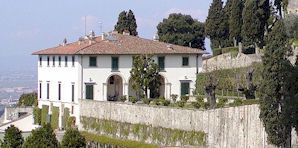
• Villa
Medici at Fiesole often considered to be largely the work of Michelozzo most
likely owes its design to Leon Battista Alberti, and as such is the
prototype of the Tuscan Renaissance villa. It enjoys a marvellous
location in the cool hills of Fiesole,
overlooking Florence. More
about Villa Medici at Fiesole.
|
|
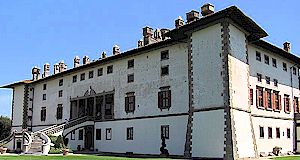
Villa Medicea di Artimino
• Villa
Medicea di Artimino is ls spectacularly located on a hilltop in
the Province of Prato. It was built as a hunting lodge for Ferdinand I
de' Medici (1549-1609) according to the designs of Bernardo
Buontalenti (1536 – 1608). The work was completed in just four years,
from 1596 to 1600. More
about Villa Medicea di Artimino.
|
 |
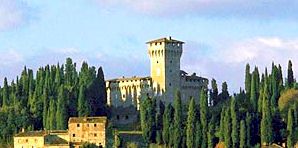
Villa Medicea di Cafaggiolo
•
Villa Medicea di Cafaggiolo is a castellated Renaissance villa situated near Barberino di Mugello in the valley of the River Sieve
(Val di
Sieve), some 25 km north of Florence. It was one of the oldest and most favoured of the Medici family estates, having been in the possession of the family since the 14 C.
The villa was reconstructed following designs of the famous Renaissance architect Michelozzo in 1452, becoming a meeting place for some of the greatest intellectuals of the Italian
Renaissance. More
about Villa Medicea di Cafaggiolo.
|
|
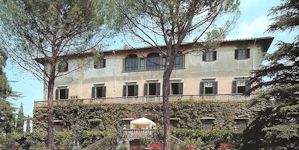
Castello di Uzzano
•
Uzzano Castle retains its designation as a "castello" - a
castle - but little remains of the original fortified structure. Uzzano
is now a fine Renaissance villa, privately owned and located near Greve
in Chianti,
with a double-columned façade of white plaster and pietra serena. There are a few remains of the original rectangular mediaeval watch tower. The italianate garden was restored in the 18 C with the addition of a double staircase and some statues.
The villa is no longer associated with the wine-producing lands it once
owned and which retain the name Castello di Uzzano as a brand. More
about Castello
di Uzzano.
|
|
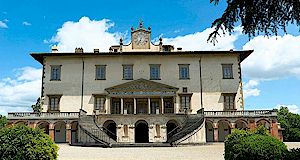
Villa Poggio a Caiano
• Villa Poggio a Caioano rwas built by Lorenzo de' Medici
after a period of intensive land acquisition by the Medici family, in
the area of Poggio a Caiano, between 1470 and 1474. Lorenzo commissioned
Giuliano da Sangallo to build a villa that became the prototype of
Tuscan noble residences for several centuries. More
about
Villa Poggio a Caiano.
|
 |
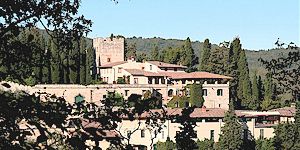
Castello di Verrazzano
•
Verrazzano Castle is another "castello" which was long ago
expanded in the form of a renaissance villa. It is situated in a
magnificent panoramic location overlooking the Val di Greve near Greve
in Chianti.
After years of neglect following the extinction of the Verrazzano
family, it has now been restored to its former glory. The castello is
famous as the birthplace of Giovanni di Varrazzano, the navigator who
discovered New York harbour and explored much of the east coast of what
is now the USA. It is a famous wine producing property and can be
visited for wine tours. More
about Castello
di Verrazzano.
|
|
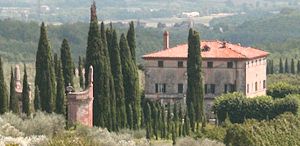
Villa Cetinale
• Villa Cetinale
is a 16 C
Tuscan villa located near Sovicille
south of Sienna. It was designed in the 1600s by Carlo Fontana, a pupil of Bernini, and built by Cardinal Flavio Chigi for his uncle Fabio Chigi, Pope Alexander VII. The gardens at Villa Cetinale are among the most beautiful in Italy. Cardinal Flavio Chigi left the Cetinale estate to his grandchildren, who retained the property for three centuries, until it was bought in 1977 by the English peer Lord
Antony Lambton, who carried out careful, conservative restoration work that restored Villa Cetinale to its former
glory. More
about Villa
Cetinale.
|
|
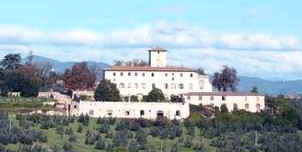
Villa Corsini a Mezzomonte
• Villa Corsini a Mezzomonte
near Florence belonged to the Buondelmonti family in the 11 C. The building was initially a fortified farm. The current structure
is in typical Renaissance style, a square with a central courtyard. The interior
is famous for its magnificent frescoes representing scenes from "Orlando
Furioso". More
about Villa Corsini a Mezzomonte.
|
|
Castello di Vicchiomaggio
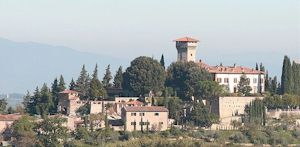
• Castello di Vicchiomaggio is
a Renaissance villa located in the Val di Greve and built around a much earlier
mediaeval tower. The remains of a Lombard castle were transformed at the end of the
1300s into a villa belonging to the Florentine Gherardini family and later the Scolari family.
It has belonged to John Matta for many years and is famous for the quality of
its wines. The castle also offers wine tours and accommodation. More
about Castello di Vicchiomaggio.
|
|
Villa Vignamaggio
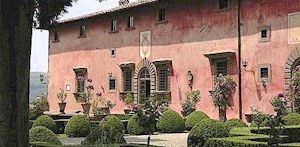
• Villa Vignamaggio
near
Lamole
and
Greve in Chianti
belonged to the Gherardini and later the Gherardi families and shows the
influence of Brunelleschi in its fine facade. Its italianate garden was restored
in the 20
C. More
about Villa Vignamaggio.
|
|
Villa Aiola
•
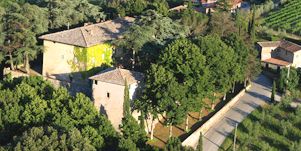
Villa Aiola near Castelnuovo
Berardenga was built in the 17 C on the ruins of the castle of the same name, in a strategic position on the border between the territories of Florence and Sienna. At the end of the 1600s, the castle lost its
military importance and became a villa farmhouse. It is possible to reach the villa over a drawbridge rebuilt over the now dry
moat. More
about Villa Aiola.
|
|
Villa Gamberaia
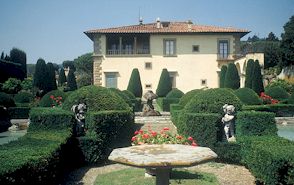
• Villa Gamberaia
at Settignano near Florence. The designer of villa Gamberaia
has not been identified, but building was begun in 1610 for Zanobi Lapi whose
descendents laid out the gardens between 1624 and 1635. During the 18 C, the Capponi family
embellished the grounds with statuary and fountains. Villa Gamberaia exemplifies Tuscan villas of the era in which a close association existed between the garden and its agricultural surroundings and which retained such conservative features as
a limonaia, allées, ilex groves, terracotta figures, sculptured hedges, and pebble mosaic walks.
More
about Villa Gamberaia.
|
|
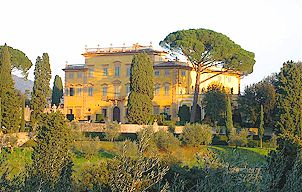
Villa La Pietra
• Villa La Pietra on via Bolognese
about a mile from Florence was the home of Sir Harold Acton, author and
aesthete, for much of the 20 C and is now the property of the University of New
York. The villa originates from the 15 C and was bought and restored at the end
of the 19 C by Arthur Acton, father of Harold, who furnished it entirely with
antiques. The Renaissance garden was also restored. After he left China in 1939,
Harold Acton moved into the villa and lived there until his death in 1994. He
wrote a number of historical works, biographies and his own autobiography while
living at Villa La Pietra. More
about Villa
La Pietra.
|
|
Villa Demidoff
(Villa Pratolino)
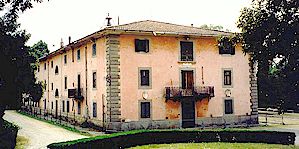
• Villa Demidoff
at Pratolino.
The Villa Medicea di Pratolino (Villa Demidoff di Pratolino) is a patrician villa located 12 km north of Florence. The original 16 C villa fell into decay and was demolished, and later the estate was bought by Prince Paolo Demidoff who, in 1872, had the pages' quarters turned into the existing villa. However, the park is magnificent and in it there are the remains of artificial caves and fountains. Of the original Renaissance property, what remains today is the colossal statue-fountain of the Apennine by Giambologna, together with the adjacent lake, the statue of the Mugnone and the hexagonal chapel designed by
Buontalenti. More
about Villa Demidoff.
|
|
Villa Celsa
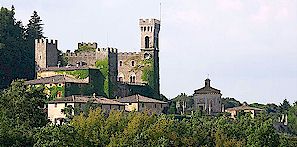
• Villa Celsa
near Sovicille
south of Sienna
constructed as one of the Republic of Sienna's defence bastions and
transformed into a villa in the 1500s by its owner, Mino Celsi. The
villa retains its 16 C character despite numerous changes over the
years. It has a splendid italianate garden laid out on one of its terraces,
the elaborate layout and architectural additions creating an attractively striking effect.
More
about Villa Celsa.
|
|
Villa medicea dell'Ambrogiana
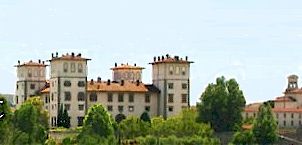
• Villa medicea dell'Ambrogiana
near
Montelupo Fiorentino
is a huge
country villa used by the Medici as a hunting lodge. A contemporary picture by
Giusto Utens shows spectacular italianate garden bounded by the Arno. It was
used as a psychiatric prison for many years and is now restored and the park is
open to the public. More
about Villa dell'Ambrogiana.
|
|
Villa di Monaciano
•
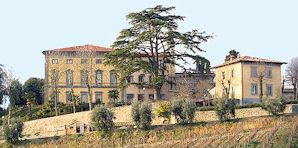
Villa di Monaciano,
in contrast to many other famous Tuscan villas, is not a renaissance
structure but dates from the 18 C and reflects the stylistic renewal
sweeping Florence at that time. It has a splendid English garden and an
antique hothouse, still in use and evidence of the botanical interests
of the founder of the villa, Alessandro Pucci Sansedoni, an 18 C Siennese nobleman living in Florence.
More
about Villa di Monaciano.
|
|
Villas near Anghiari
•
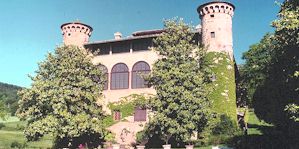
Villas near Anghiari
- the Upper Tiber Valley and the overlooking hills are the location of
many ancient castles that have been turned into villas over the
centuries. Among them are Castello Montauto, Castello dei
Sorci, Castello Galbino and Villa La Barbolana. More
about the Castles and Villas near Anghiari.
|
|
Villa Le Corti
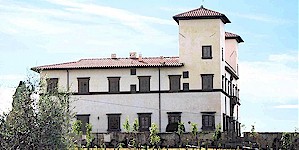
• Villa Le Corti near San
Casciano Val di Pesais one of the finest Renaissance country villas in Tuscany. It has
belonged to the Corsini family since 1427. In the early 17 C it was
converted by the painter and architect Santi di Tito into an imposing rectangular edifice dominated by the twin towers still there today.
The Villa is surrounded by a splendid park. More about Villa Le Corti and the Corsini family.
|
|
Villa Arceno
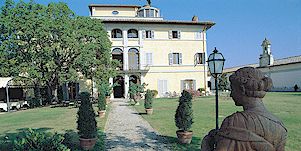
• Villa Arceno near Castelnuovo
Berardenga was built at the end of the 17 C by Flaminio Del
Taia. In the early 19 C, the property passed into the hands of the Piccolomini Clementini, who renovated the villa and built the huge park that surrounds it.
The immense park that spreads out in front of the villa was designed by Agostino Fantastici in around 1833. It extends for several km and ends in an artificial lake that is completely surrounded by woodland.
More about Villa Arceno.
|
|
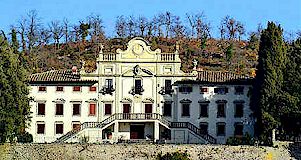
Villa Vistarenni
• Villa Vistarenni near Gaiole
in Chianti dates from 1621 onwards. The villa was originally
designed in Renaissance style but was extensively modified over the
years, especially in the first years of the 20 C when the facade was
extensively embellished in 19 C style by the Florentine architect Ludovico
Fortini. The clock embedded in the top of the facade makes the villa
instantly recognisable across its vineyards. More
about Villa
Vistarenni.
|
|
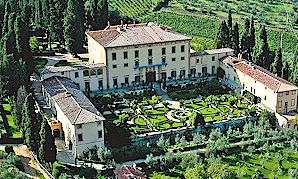
Villa Poggio Torselli
•
Villa Poggio Torselli dates from 1427
or earlier and is famous for its splendid italianate garden. Poggio
Torselli extends over the Tuscan hills in the municipality of San Casciano in
Val di Pesa, in the region of the Chianti Classico. Its beautiful landscape
offers a view of verdant expanse of 30 hectares of vineyards and 2,700 olive
trees. More about
Villa Poggio Torselli. |
 |
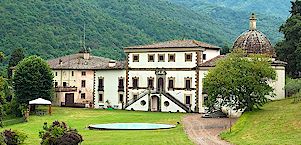
Villa Vernaccia a Cintoia
•
Villa di Cintoia is a fine, private 18
C villa located in a fairly remote part of Chianti. The
villa preserves its 18 C appearance. Outside the elegant windows are decorated
with small volutes. In the middle, there is a striking staircase with two
flights of steps, which leads straight to the first floor. Inside the halls, we
can still see the large fireplaces in pietra serena and the stucco work
and frescoes on the walls and ceilings. Two lower side wings extend and soften
the massive central part of the structure. More about
Villa Vernaccia a Cintoia. |
 |
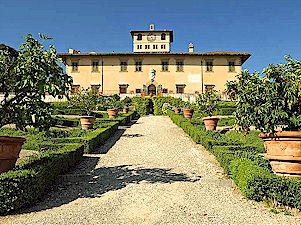
Villa La Petraia
•
Villa La Petraia is a splendid
Mediciean villa located on a terrace with a wonderful view out over Florence in
the distance. Probably because of its secluded location near the village of Castello, this royal palace is not on the main tourist circuit and yet it is
definitely worth a visit both for its magnificent interior and the surrounding
gardens. The wall paintings in the chapel on the first floor and in some of the
rooms date from the time of the
Lorraine rulers of Tuscany and the palace owes its present appearance,
with iron and glass panels covering the courtyard, transforming it into a large
ball room to the royal family of Savoy. More about
Villa La Petraia.
|
 |
)
)
)
)
)
